
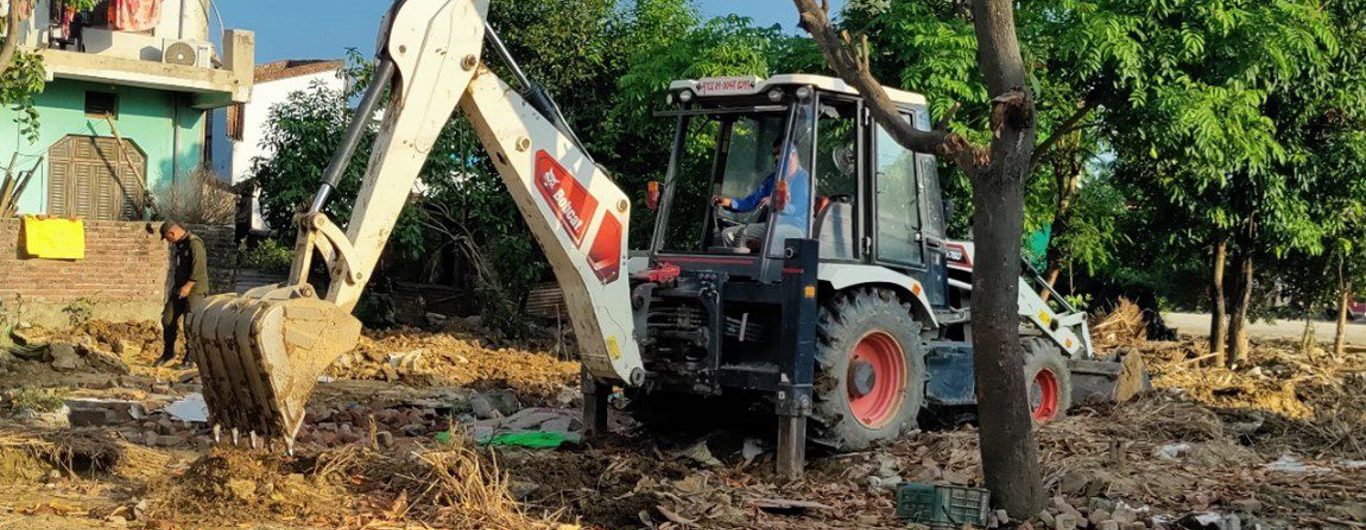
The Nepalese government’s failure to establish a regulatory framework for the Right to Housing Act, coupled with local authorities’ blatant disregard for the law, has resulted in forced evictions that have left hundreds homeless, Amnesty International said in a new report.
The report, “’Nowhere to go’: Forced evictions in Nepal”, highlights the devastating impact on already marginalized communities, including Dalits and Indigenous Peoples, which are disproportionately affected by the forced evictions. It also reveals the authorities’ failure to uphold legal safeguards and address gaps in regulations needed to implement provisions in the Constitution and the 2018 Right to Housing Act that are aimed at preventing forced eviction.
“There is an ever-widening gap between the legal protections promised in Nepal’s constitution and the reality for marginalized communities in the country, who continue to live in fear of being evicted with no due process, no regard for their precarious circumstances and no hope of compensation to help rebuild their lives elsewhere,” said Nirajan Thapaliya, Director at Amnesty International Nepal.
“The authorities are failing in their legal duty to protect the rights of the landless, some of the most vulnerable in society.”
The report focuses on emblematic cases of forced evictions between 2020 and 2024 that took place across Nepal including in Kathmandu, Siraha, Sunsari, Jhapa and Kailali districts. Together they represent diverse regions and types of eviction. In some cases, evictions took place as a result of development projects in urban settings, in others forced evictions were carried out in conservation areas in community forests and national parks.
The authorities are failing in their legal duty to protect the rights of the landless, some of the most vulnerable in society.
Nirajan Thapaliya, Director at Amnesty International Nepal
Due process failures
In the cases documented, the authorities showed complete disregard for Nepal’s human rights obligations under national and international law. The cases highlight the failure of authorities to put in place human rights safeguards against forced evictions, including consultations with the affected communities to explore alternatives to eviction and provision of adequate notice for their removal.
On 23 June 2024, households living in the Purano Airport area in Dhangadhi Sub-Metropolitan City, Kailali were forcibly evicted and their homes were demolished by bulldozers even though there was a process underway by the Land Issue Resolving Commission to confirm the status of the residents, an essential step towards guaranteeing security of tenure. Local authorities ignored the outcome of the verification process, including temporary certificates of land occupation that had been issued to residents by the Commission. They later admitted that nine of the 13 families evicted should not have been forced out, as they were entitled to special legal protection against homelessness.
“We have land possession documents, electricity bills, etc. — yet none of these safeguarded us from eviction,” said a member of one of the affected communities.
Other government failures include the failure to uphold specific protections for groups vulnerable to discrimination and marginalization, such as older people, children and persons with disabilities. In addition, authorities failed to follow procedures stipulated by the Lands Act relating to the identification and verification of landless Dalits and residents of informal settlements.
Moreover, authorities also failed to engage the affected communities in a process of genuine consultations prior to the evictions and provide them with adequate notice, requirements set forth both in Nepal’s Right to Housing Actand international human rights standards.
‘We have nowhere to go… How will we survive?’
Many residents described the dehumanizing way in which they were forced from their home without even being given a chance to gather their clothing, medicine, their children’s books or important legal identity documents.
“Our homes were bulldozed from all sides. Now, we have nowhere to go and nothing to eat. How will we survive?” said one of the victims of forced evictions in Bhajani Municipality, Kailali.
At least three eviction sites included some of the most vulnerable – older people, pregnant women, and newborns.
Bishnu Nepali*, a 23-year-old mother from Bhajani, said: “I just had a baby, and now we have no roof, no electricity, and no mosquito net. Living like this is unbearable.”
In Dhangadhi, a young woman who had just given birth said she had already been uprooted once before: “We didn’t come here out of greed. We were forced to move after a landslide destroyed our home. But the authorities treated us as if we have committed a crime just for seeking refuge in this land.”
The report highlights the severe emotional, physical, and psychological impact caused by forced evictions, loss of property, lack of access to food and water, loss of livelihood, lack of access to education.
Homelessness was apparent in all three of the eviction sites visited by Amnesty International. This is in clear violation of international law, which obligates states to protect all people from forced evictions regardless of land tenure status and to refrain from rendering individuals homeless.
Communities that were evicted in most of the cases documented in the report did not receive any compensation or where they did, it was wholly inadequate. When resettlement was offered, it was without prior consultation with the affected community and without due consideration for their needs, such as the size of the family or the provision of essential services.
Without urgent and coordinated action to implement the right to adequate housing and establish regulatory frameworks, the cycle of forced evictions and human rights violations will persist in Nepal.
Nirajan Thapaliya
Systemic gaps enabling forced evictions
Without the necessary regulatory framework to implement many of the provisions of the Right to Housing Act, legal protections are left largely ineffective. The failure to harmonize conflicting earlier legislation with more recent Nepali laws to protect fundamental rights has further undermined enforcement, while a lack of coordination and cooperation between federal and local governments has worsened the situation.
Oversight mechanisms have also been largely ineffective. For instance, the National Human Rights Commission has monitored some eviction incidents and issued recommendations for redress. However, its response has fallen short of the seriousness of these violations. With adequate resources, the Commission could play a stronger role by documenting systemic patterns of forced evictions and conducting independent investigations.
“The Nepali authorities must safeguard the right to adequate housing, end the practice of forced eviction and ensure due process when evictions are deemed necessary. Without urgent and coordinated action to implement the right to adequate housing and establish regulatory frameworks, the cycle of forced evictions and human rights violations will persist in Nepal,” said Nirajan Thapaliya.
*Names changed to protect identity